The Stories We Tell

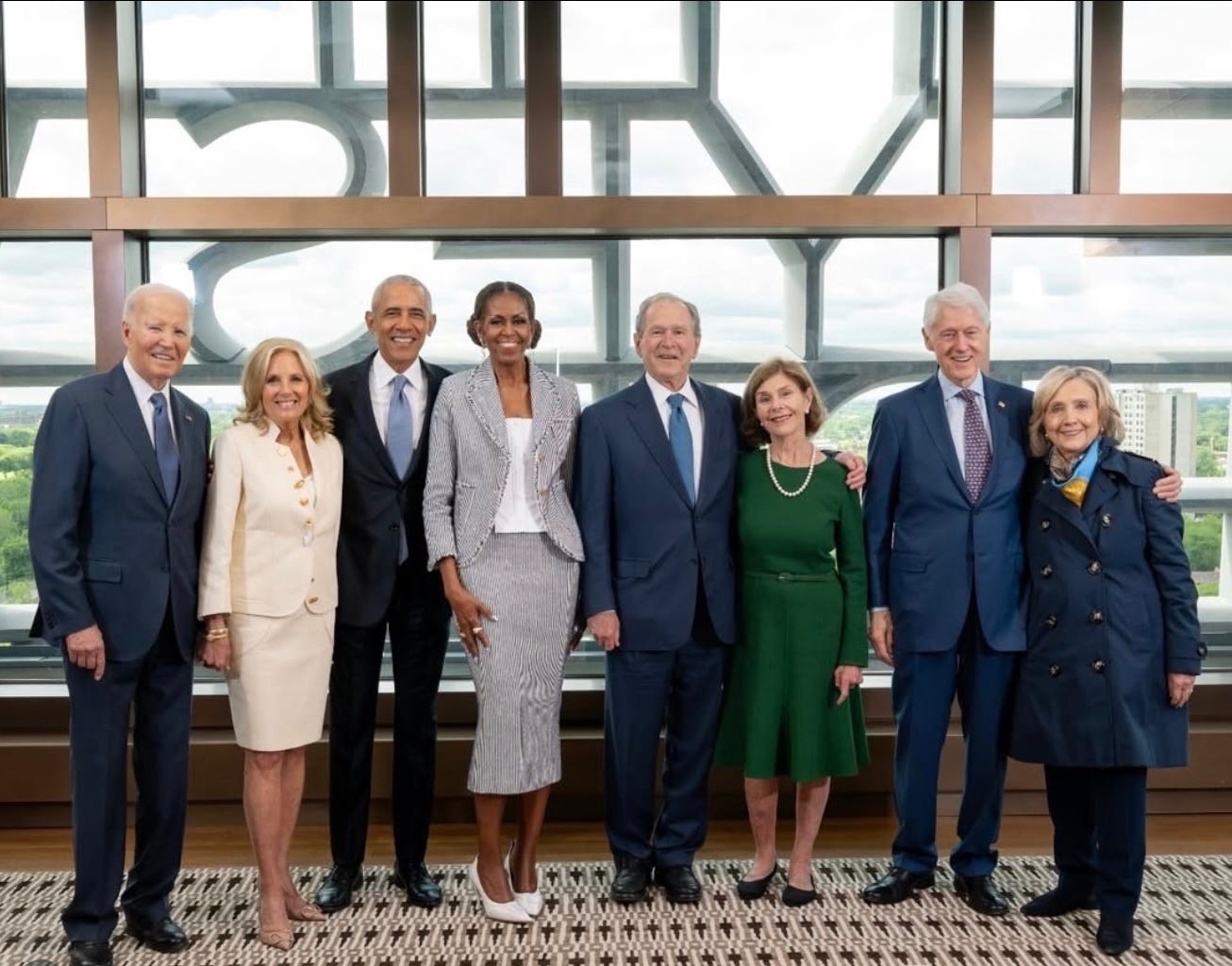
Somebody’s going to have to explain to me the presence of George W. Bush at the opening of the Obama Presidential Center.
Because it makes no sense.
Bush really was there, right? I didn’t imagine it? The photos and videos seem real, but with the virulent rise of AI, who can say what’s real and what’s a malicious fake?
Turns out, anyone can.
Bush, by any good-faith metric, is a malicious fake, publicly masquerading as a respectable past president.
More categorically, he is a war criminal, responsible for horrific crimes against humanity.
If you can stand a reminder, let’s recap:
Under false pretenses (non-existent “weapons of mass destruction”), the Bush administration ginned up an illegal war of choice in Iraq, costing hundreds of thousands of lives and trillions of dollars.
Throughout wars in Afghanistan and Iraq, Bush “denied prisoners due process rights while in US custody.” That’s a polite way to say he violated US Federal law, international law, and the Geneva Conventions in numerous ways, personally authorizing the torture of helpless war prisoners (as he confesses in a 2010 memoir).
Additionally, he disappeared people to secret prisons outside the US (“extraordinary rendition”) for the purpose of torture and other crimes that were compared, at the time, to those that earned the death penalty in post-WWII tribunals.
At home, Bush:
Claimed the right to wage future “pre-emptive wars” as he deemed necessary (in violation of the War Powers Act of 1973, prohibiting a president from unilaterally deploying US military forces for more than 60 days).1
Rounded up hundreds of Arab and Muslim immigrants in the US, holding them in solitary confinement for months without charges or legal representation.
Secretly authorized the NSA to conduct warrantless wiretapping and monitoring of the email of U.S. citizens.
These are just a few of the things we know about—there are no doubt many others that remain behind the wall of “national security.”
What we do know is that in the United States of America—the “shining city on the hill,” the self-appointed defender of democracy around the globe—Bush got away with all of it.
Why?
Because former president Barack Obama blithely declined to pursue justice.
“We must avoid any temptation simply to move on. We must instead be honest with ourselves and the world as we condemn our nation’s past transgressions and reject Bush’s corruption of our American ideals.” —Indiana University law professor Dawn Johnsen, former nominee to head the Obama administration’s Office of Legal Counsel
Instead of confirming that no one in the US is above the law, Obama early in his first term said, “This is a time for reflection, not retribution. I respect the strong views and emotions that these issues evoke. We have been through a dark and painful chapter in our history. But at a time of great challenges and disturbing disunity, nothing will be gained by spending our time and energy laying blame for the past."
One might argue that justice is not retribution—and that reflection is about as useful as “thoughts and prayers” when it comes to preventing future presidents from defacing the Constitution. But Obama decided otherwise.
In the same week, Obama released memos describing torture methods approved by Bush. In a statement, Obama said "…it is our intention to assure those who carried out their duties relying in good faith upon legal advice from the Department of Justice, that they will not be subject to prosecution."
The statement is a variation on “just following orders,” turning a blind eye to a history of atrocities that were “legal” when they were committed. It also suggests those who carried out acts of torture “in good faith” somehow could not have known any better, and shouldn’t be held accountable.
By “simply moving on,” Obama effectively pardoned crimes far more deleterious than those committed by J6 insurrectionists. Evidence of that is the bright red line between the lawlessness of the Bush administration and its grotesque spawn, Trump 2.0.
Still, none of this explains why Obama—one of the two of the most admired Americans in the world (Michelle Obama is the other)—would continue all these years later to rehabilitate and normalize the Bush legacy.
The inaugural day of the Obama Presidential Center should’ve been a joyous celebration of “Yes, We Can.” Instead, it was a jarring reminder of failure, and a betrayal of what once might’ve been described as “bedrock principles.”
~~~
American history echoes, rhymes, and repeats itself:
Former president Andrew Johnson disastrously refused to hold the South accountable for its crimes against the Union—in fact, he enabled it—resulting in generations of trauma and doctrinal deprivation for Black Americans.
Former president Gerald Ford presumptuously declared “Our long national nightmare is over” and pardoned his disgraced predecessor, Richard Nixon. Telegraphing our foundational reality that “equality under the law” means one thing when applied to privileged Americans and something else entirely for everyone else.
~~~
In his book, How We Disappear, author and historian Thomas Mullaney says, “No orderly thing, nothing that has been put ‘in formation,’ whether by humans or by the universe at large, stays in order. Threads fray. Paper yellows. Parchment curls. The deepest bas and highest relief of inscriptions, chiseled in the hardest of stones, smooths into illegible planes.”
Whether by commission or omission, intentionally distorting our own history—the stories we tell ourselves and teach to generations of our children—is how we all disappear.
Democracy, as an idea, is like a Fabergé egg—beautiful, but fragile.
In its current state, US democracy is more like a lump of coal—misshapen, dark, disappointing—but with endless, unrealized potential.
It’s not too late for it to become something better. But that will only happen if people want it and respect it enough to keep up the pressure.
~~~
The War Powers Act of 1973 was passed by Congress (after overriding Nixon’s veto) in response to the perceived (and actual) failures of the Vietnam War, which occurred without congressional approval. It set out the three methods for which the US Military may be used in conflict. The first, allows the president to commit military forces abroad without congressional approval for no more than sixty days. The second requires to Congress issue an Authorisation for the Use of Military (AUMF) which allows the president to continue the use of military force without a formal declaration of war. The president must follow any stipulations set out by the AUMF. The third is where Congress may pass a formal declaration of war (its Article 1 power in the Constitution). A formal war declaration has not occurred since World War II.
(Fletcher V, B. (2023). The US War in Afghanistan and the War Powers Act: A Natural Experiment. https://scholarworks.uark.edu/econuht/52/ )
~~~
I have always looked askance at the warm relationship the Bush and Obama families have had, wondering how they square the personal with the official. I still don't get it.
I love your writing style, Michael. Your ideas and philosophy of life has always resonated with me. Thank you for this